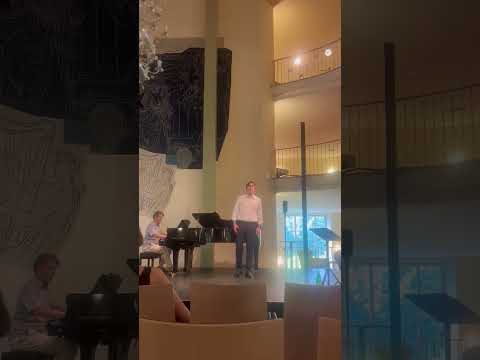
Àngel Arévalo is a lyric tenor at the beginning of his professional career, currently based in Maastricht and active across Spain, the Netherlands, and Germany. His artistic identity is shaped by a rare dual formation: a Bachelor's degree in both Classical Guitar and Classical Singing from ESMUC Barcelona.
His vocal studies have led him through the prestigious "Alfredo Kraus" Chair at the Reina Sofía School of Music under Prof. Susan Bullock CBE, and he is currently pursuing a Master's in Singing at the Conservatorium Maastricht with Prof. Axel Everaert.
Particularly drawn to interdisciplinary artistic projects, Àngel is building a versatile repertoire from Mozart and Rossini to Puccini and Verdi — with roles performed at the Teatro Cervantes Málaga, Festival d'Òpera de Tarragona, Berlin Opera Academy, and Brussels Operette Theater.
| Alfredo Germont | La Traviata | Verdi | In preparation | In prep. | |
| Nemorino | L'elisir d'amore | Donizetti | Role | ||
| Rodolfo | La bohème | Puccini | In preparation | In prep. | |
| Don Ottavio | Don Giovanni | Mozart | In preparation | In prep. | |
| Belmonte | Die Entführung aus dem Serail | Mozart | In preparation | In prep. | |
| Raoul de Gardefeu | La Vie parisienne | Offenbach | Brussels Operette Theater | Role | |
| Adam | Der Vogelhändler | Zeller | Brussels Operette Theater | Role | |
| Odoardo | Don Procopio | Bizet | Teatro Cervantes, Málaga | Role | |
| Ferrando | Così fan tutte | Mozart | Berlin | Role | |
| Rinuccio | Gianni Schicchi | Puccini | Berlin | Role | |
| Giuseppe | La Traviata | Verdi | Festival d'Òpera de Tarragona | Role | |
| Barigoule | Cendrillon | P. Viardot | Role | ||
| Argirio | Tancredi | Rossini | Opera Zuid | Role | |
| Federico | La prova d'un opera seria | F. Gnecco | Opera Zuid | Role | |
| Cervantes | Das Spitzentuch der Königin | Johann Strauss II | Brussels Operette Theater | Role | |
| «Tombe degli avi miei» · duet «Lucia, perdona» | Lucia di Lammermoor | Donizetti | Aria | ||
| «Come uno spirto angelico» + cabaletta | Roberto Devereux | Donizetti | Aria | ||
| «Spirto gentil» | La favorita | Donizetti | Aria | ||
| «La mia letizia infondere» | I Lombardi | Verdi | Aria | ||
| «Che gelida manina» · duets | La bohème | Puccini | Aria | ||
| «Addio fiorito asil» · duet «Vogliatemi bene» | Madama Butterfly | Puccini | Aria | ||
| «Ah! lève-toi, soleil» · duets | Roméo et Juliette | Gounod | Aria | ||
| «Salut, demeure chaste et pure» | Faust | Gounod | Aria | ||
| «Pourquoi me réveiller» | Werther | Massenet | Aria | ||
| «Dalla sua pace» · «Il mio tesoro» | Don Giovanni | Mozart | Aria | ||
| «O wie ängstlich» · «Frisch zum Kampfe» | Die Entführung aus dem Serail | Mozart | Aria | ||
| Lenski's aria | Eugene Onegin | Tchaikovsky | Aria | ||
| «Lonely House» | Street Scene | K. Weill | Aria | ||
| «Wenn es Abend wird» | Gräfin Mariza | Kálmán | Aria | ||
| «Who are you, sir?» | Cox and Box | Sullivan | Aria | ||
| Javier | Luisa Fernanda | Moreno Torroba | Brussels Operette Theater | Role | |
| «Yo no sé qué veo en Ana Mari» | El caserío | Guridi | Aria | ||
| «No puede ser» | La tabernera del puerto | Sorozábal | Aria | ||
| «Paxarín, tú que vuelas» | La pícara molinera | Luna | Aria | ||
| Siete canciones populares españolas | Canciones | Falla | Aria | ||
| Schwanengesang · Winterreise (sel.) · «Ständchen» | Lieder | Schubert | Lied | ||
| Liederkreis Op. 24 & Op. 39 | Lieder | Schumann | Lied | ||
| «Morgen» · «Cäcilie» + wide selection | Lieder | R. Strauss | Lied | ||
| Tre Sonetti di Petrarca | Années de pèlerinage II | Liszt | Concert project — see Projects | Lied | |
| «Après un rêve» · «Fleur jetée» + selection | Mélodies | Fauré | Mélodie | ||
| Mélodies | Mélodies | Duparc | Mélodie | ||
| Songs of Travel · «Silent Noon» | Songs | Vaughan Williams | Eng. Song | ||
| Seven Sonnets of Michelangelo | Songs | Britten | Eng. Song | ||
| «Every valley» · «Thou shalt break them» | Messiah | Handel | Oratorio | ||
| Tenor soloist | Misa Criolla | Ramírez | In preparation | Oratorio | |
| Canciones españolas antiguas | Songs | García Lorca | Guitar | ||
| Siete canciones populares españolas | Songs | Falla | Guitar | ||
| Folk Songs Arrangements | Songs | Britten | Guitar | ||
| Volver | Tango | Gardel / Le Pera | Guitar | ||
| Ständchen (guitar & voice version) | Song | Schubert | Guitar |
A didactic concert programme conceived for schools, conservatories, and general venues, exploring Liszt's celebrated settings of Petrarch's sonnets. The programme presents the vocal versions composed for tenor and piano alongside the solo piano versions, illuminating why Liszt wrote two entirely distinct treatments of the same texts — and what this reveals about the relationship between poetry, the singing voice, and the keyboard.
Between each piece, an actor presents the original Petrarch sonnets and contextualises their place in literary and musical history, making the evening both an intimate concert and an accessible introduction to one of the song repertoire's most profound cycles.
Triolé is a chamber trio formed at the Conservatorium Maastricht, bringing together voice, violin, and piano in an intimate concert format. The ensemble explores the crossroads between art song, classical chamber music, and interdisciplinary performance, presenting programmes that engage both seasoned concert-goers and new audiences.
The trio has performed at Domani — Podium voor morgen (Maastricht) and the Muziekgebouw Eindhoven, where they were invited as the first Lunchtime Concert of 2025.
For bookings, collaborations, artistic projects, or press enquiries, please reach out through any of the channels below.